


FIPA-Tunisia 2024. All rights and photo credits reserved Numeryx Tunisia
FIPA-Tunisia 2024. All rights and photo credits reserved Numeryx Tunisia
A strategic asset that remains under-utilised
A global leadership that demands attention… and an opportunity to be seized
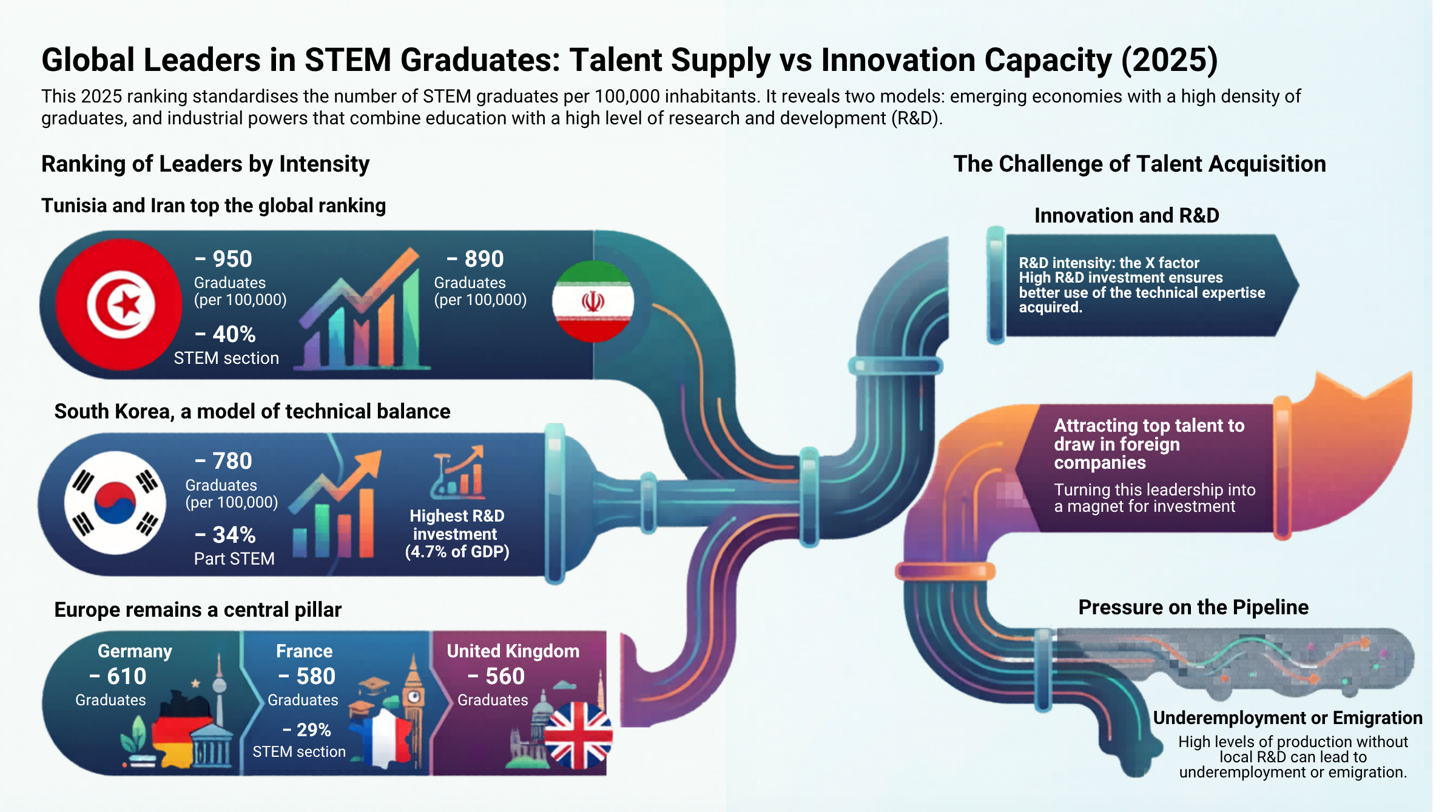
Tunisia now ranks among the world’s top countries in terms of the number of STEM (Science, Technology, Engineering and Mathematics) graduates per capita. According to the 2025 report by the UNESCO Institute for Statistics, published in partnership with the World Bank, the country has nearly 950 STEM graduates per 100,000 inhabitants, a level unprecedented on the international stage.
This exceptional standing confirms a reality that is often underestimated: Tunisia possesses one of the world’s largest pools of technical talent.
A steady rise that underscores an ambitious educational strategy
This achievement is no coincidence. It is part of an upward trajectory:
– 2018: 850 graduates (2nd in the world)
– 2020: 900 graduates (reaching 1st place)
– 2023: 920 graduates
– 2025: 950 graduates (consolidation of leadership)
Major industrial powers lag behind: South Korea (780), Germany (610), France (580), the United Kingdom (560)…
Tunisia also stands out for the proportion of STEM subjects in higher education (nearly 40%), which is significantly higher than in several European countries.
This focus reflects a strategic choice: to prepare an economy based on knowledge and technical skills.
The foundations of the Tunisian model
Three key factors account for this performance:
1. A proactive academic focus The Tunisian education system places a strong emphasis on science and technology courses, producing a large number of engineers, technicians and IT specialists every year.
2. A favourable demographic profile With a young and educated population, Tunisia benefits from a steady influx of new talent.
3. A competitive position In terms of the density of STEM graduates, Tunisia even outperforms countries that invest heavily in R&D, such as South Korea.
The Tunisian paradox: a talent pool that is poorly utilised
Despite this comparative advantage, a major challenge remains: the absorption of these skills by the national economy.
Indeed, there is a clear disconnect that poses a significant structural risk: that of seeing a strategic advantage turn into an erosion of human capital.
A key factor in attracting foreign investment
For international investors, the availability of talent is a decisive factor. Yet Tunisia has a unique advantage in this regard… one that is still under-utilised.
Without a business sector capable of absorbing these candidates, the pull factor remains limited.
Conversely, making better use of this potential could strengthen Tunisia’s position as a regional hub for engineering and innovation and as an outsourced R&D platform.
Turning this advantage into an economic driver: the priorities
To move from a talent-production model to a value-creation model, several steps are required:
1. Develop innovation ecosystems such as specialised technology parks, sector-specific clusters (automotive, IT, biotech, etc.), public-private R&D hubs…
2. Strengthen investment incentives through targeted tax breaks for R&D, increased support for innovative businesses and the facilitation of international partnerships
3. Harnessing Tunisian talent abroad through ‘brain circulation’ programmes, co-investment with overseas expertise, and the transfer of know-how
4. Make better use of this asset on the international stage by incorporating it more widely into promotional campaigns (forums, roadshows, etc.) and adopting a clear marketing positioning: Tunisia = Talent Hub
Tunisia has no shortage of talent. It produces more than most developed nations.
The real challenge, therefore, is no longer educational, but economic and strategic: to create the conditions to retain, develop and make the most of these skills.
If this challenge is met, Tunisia will undoubtedly become North Africa’s leading STEM hub